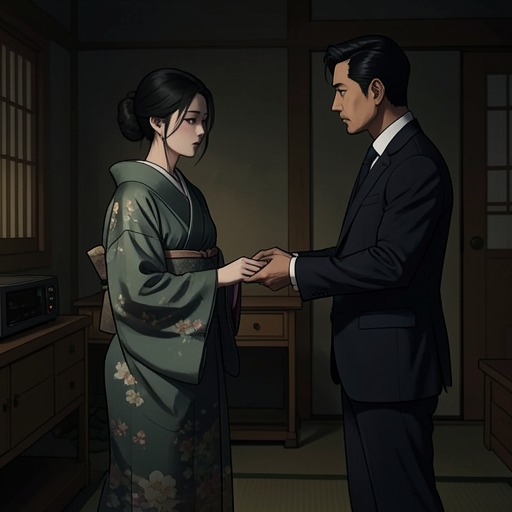
Chiyo meets the Chairman and resolves to become a geisha
Memoirs of a GeishaChiyo meets the Chairman and resolves to become a geisha at a moment when she believes her future has narrowed to endless labor. Their brief encounter beside the Shirakawa Stream changes that outlook: the Chairman treats her with unexpected kindness, and she turns that experience into a purpose. The scene is both a first meeting and a decisive change in Chiyo’s understanding of what becoming a geisha might mean.
The impasse in Gion
For a year and a half, Chiyo has been condemned to maid’s work after her training was stopped. She does not claim to want to become a geisha, but knows she does not want to spend her life scrubbing the courtyard stones. Standing in the school garden, she watches girls her own age pass by together. Their ordinary journey back for lunch looks to her like movement from one purposeful part of life to another, while she expects only to return to her chores. The sight makes her fear that other girls in Gion will advance and leave her behind.
She walks toward the Kamo River and passes the Minamiza Theater, where banners announce that Shibaraku is playing. The crowds entering the theater, and the geisha moving among men in suits and kimono, seem to embody the active lives from which she is excluded. Even when she turns away from the avenue and follows the Shirakawa Stream, the people around her appear to be hurrying toward purposes of their own. The water, too, seems to move with direction, flowing toward the Kamo River and onward to Osaka Bay and the Inland Sea. Against this motion, Chiyo sees herself as an abandoned island, with neither a past nor a future, and collapses weeping beside the stream.
A stranger’s kindness
The Chairman interrupts Chiyo’s isolation by telling her, “Why it's too pretty a day to be so unhappy.” In her experience, a man on the streets of Gion would be unlikely to notice a girl in her position, much less address her kindly. His manner suggests that she might be someone worthy of respect, perhaps the daughter of a good friend. For a flicker of time, she imagines a different world, one where she might be treated fairly and where fathers did not sell their daughters. The noisy life around her recedes from awareness as she looks up at the stranger.
The encounter’s significance lies not in any promise the Chairman makes about Chiyo’s future, but in the contrast between his gentleness and the cruelty she has known. He wipes grit and tears from her face and tells her she is beautiful and has nothing to be ashamed of. He recognizes that someone, or life itself, has been cruel to her. Chiyo knows the source of her suffering, but answers that she does not know. The Chairman responds that people do not find as much kindness in the world as they should. His words do not undo what has happened to her; they give her a moment in which her humiliation is met with compassion rather than indifference.
The gift and its meaning
The Chairman asks whether Chiyo prefers sweet plum or cherry and explains that he has passed a vendor selling shaved ice with syrup. He gives her a coin and his handkerchief, wrapping the coin in the cloth so she can wipe her face afterward. The small bundle has a particular force for Chiyo: it resembles the shrouded moth that has served as a sign in her thoughts. She accepts it with a deep bow. Her gratitude is not simply for the money or the practical help. She understands the gift as evidence that the world contains something besides cruelty.
As the Chairman walks away, Chiyo feels the sadness of an experience that has ended almost as soon as it began, combined with gratitude that it happened at all. She describes herself as changing in that brief encounter from a lost girl facing a lifetime of emptiness into a girl with purpose. The change is inward and immediate; nothing in her circumstances has yet improved. That gap between her unchanged situation and newly awakened hope gives the meeting its turning-point force.
From encounter to decision
Chiyo searches for the shaved-ice vendor after the Chairman disappears. The day is not particularly hot, and she does not especially like shaved ice, but eating it will let the encounter linger. She buys a paper cone with cherry syrup and sits again on the same stone wall. The taste seems unusually complex because her senses are heightened. The ordinary act of eating becomes a way to hold on to the kindness that has just interrupted her despair.
For the first time, Chiyo envies a geisha. She imagines that if she were one, a man like the Chairman might spend time with her. She had been brought to Kyoto to become a geisha, but had previously wanted to run away if she could. Now she distinguishes becoming a geisha from being one: mere attainment of the role is not, by itself, a purpose. The life and possibilities the role might open, however, could lead toward something beyond the occupation itself. She calculates that she is nearly twelve and that, in another twelve years, she will be in her twenties; she imagines that the Chairman, whom she guesses to be no more than forty-five, would then be no older than Mr. Tanaka is already. Her new ambition is thus shaped by both immediate feeling and a long view of time.
The coin has bought more than the shaved ice requires. Chiyo takes the three coins of different sizes returned by the vendor and decides they can serve a more important purpose than keeping them as mementos. She runs to the Gion Shrine, climbs its steps, and, too intimidated to pass beneath the great two-story entrance gate, walks around it. In the courtyard she passes through a torii gate and reaches the shrine. There she throws the coins into the offertory box, claps three times, bows, and prays to be permitted to become a geisha. She is willing to endure training and hardship for the chance to attract the notice of a man like the Chairman again.
An unchanged world, a changed purpose
When Chiyo opens her eyes, the traffic on Higashi-Oji Avenue can still be heard, and the trees still hiss in the wind. Nothing outward has changed, and she cannot know whether the gods have heard her. She can only tuck the Chairman’s handkerchief inside her robe and carry it back to the okiya. The cloth is the material remainder of the encounter; the coins, by contrast, have been given away as part of her prayer.
The scene binds its change of purpose to recurring images of movement and signs. Before meeting the Chairman, Chiyo reads the flowing river as proof that every other life has direction while hers does not. Afterward, she converts the coins from a gift into an offering and chooses the difficult course she had been unwilling to accept. Her resolve does not guarantee success, and the meeting does not free her from the conditions that made her despair. Instead, it gives her a reason to face them: becoming a geisha may be a path toward a future she can imagine, rather than an end in itself. The distinction captures the encounter’s decisive effect without making kindness a simple remedy for hardship.